Posts Tagged ‘Missions’

"Christianization of Poland on April 14, 966" by Jan Matejko

“Christianization of Poland on April 14, 966” by Jan Matejko

My wife and I moved to Poland in the spring of 1999 to help the evangelical church with church planting and leadership development. Of course, at first we focused on learning Polish, and trying to understand Polish culture and worldview. My second year in Poland, I audited theology classes at the Catholic University of Lublin, in an attempt to better understand the Polish worldview.

For the past fourteen years, therefore, we have been involved in participant observation, and yet sometimes our observations did not seem to match what we expected to see from Roman Catholics. Of course, some of our dissonance was as a result of our mistaken preconceptions about Catholicism, and yet much of it was because of a real difference between what the Church officially teaches, and the functional worldview of most Poles. Hence, I looked forward to this ethnographic project, as an attempt to better understand that functional worldview, and hopefully to gain some insight into better ways to communicate the good news of the Gospel, and especially to understand the epistemology of the average Pole.

I currently pastor a Baptist church in Lublin, Poland, and lead the WorldVenture Poland team, but I did not want to build an ethnography of evangelical Poles. I discussed the project with other evangelical pastors in our area, and with our team, and one of my team members, Bruce, in Lubin, was also interested in doing the ethnographic questionnaire among his English students. So, he met with 4 men, ages 18-38, and sent me the results of his conversations. I met with 6 people, 4 women and 2 men, ages 23-51. After preparing an English questionnaire for Bruce, I met with my friend, Radek, to correct my Polish questionnaire. As a result of our meeting, we redacted the questionnaire from 33 questions to 25, but Bruce continued to use the original. All of the participants in the research are Roman Catholic, although a few would not consider themselves faithful to or in agreement with the Church’s teaching.

I have already shared this project with my teammates and with workers from other organizations here in Poland. Hopefully, our ongoing conversation and research into the Polish worldview and our Christian witness can help us better proclaim the Good News.

  1. History and Demographics

Poland was founded in 966 A.D. when King Mieszko I was baptized into the Western Latin rite. This decision meant that Poland remained Roman Catholic when some of its southern and eastern neighbors went with the Eastern (Orthodox) Church. Being Roman Catholic also meant a focus toward Rome and the West, rather than toward Constantinople and the East. As a result, religious, cultural and political ties integrated Poland with its Western neighbors, Austria and the German states, as well as with Lithuania when it also chose Catholicism. The Union of Lublin, in 1569, created the Commonwealth of Poland-Lithuania, a nation-state which for nearly two hundred years was among Europe’s largest countries.

Poland considered itself a bulwark against the Baltic pagans, the Orthodox Russians, and later, the Moslems from the east and south. The role of King Jan III Sobieski in the Battle of Vienna (1683) to turn back the Ottomans was crucial to stopping the Moslem advance into Europe. Poland was a relatively tolerant society, with large numbers of Jews, Orthodox, pagans and even Moslem Tatars holding positions of prominence. The Reformation also saw many converts to Protestantism, especially Calvinism. However, wars with Protestant Sweden, most notably “the Deluge” (1655-60), led to a marked change in Polish tolerance, including the banishment of the Arian Brothers (a sect similar to the Bohemian Brethren), and the death penalty for conversion from Catholicism.

The valiant defense of the monastery of Jasna Góra in Częstochowa during the Swedish Deluge, and the legends surrounding the icon of the Black Madonna, housed in the monastery, greatly assisted in the process of counter-Reformation in Poland. Still today, nearly every high school student in Poland makes a walking pilgrimage to the Shrine of the Black Madonna in Częstochowa. Although Poland continued to be relatively tolerant – in comparison with most other European countries – the religious beliefs of its citizens were tied to their ethnicity. Russians – Orthodox, Germans – Protestant, Jews, Moslem Tatars – and Poles were Catholic, with very few exceptions.

The Divisions of Poland among the Great Powers of Russia, Prussia and Austria in the late 1700’s, its rebirth in 1918, and World War II, led to a Poland that is today much less diverse, both ethnically and religiously. Poland is 97% ethnically Polish,[1] and is 89% Roman Catholic, 9 % non-religious, 1% Orthodox, and 0.5% Jehovah’s Witness. Lutherans are 0.22%, and Evangelicals are about 0.14% of the population.[2] The Lutheran and Orthodox adherents usually have a German or Russian ethnic background, respectively, so the common expression “to be Polish is to be Catholic” usually rings true.

  1. Social Structures

Family remains very important in Polish society. As I conducted my survey, nearly every respondent mentioned their father or, more often, their mother, as an authority figure. Those who had lost a parent believed that their dead parent still took interest in their lives, and in a couple of cases, believed that the dead loved one had intervened to rescue them from some calamity. A mass migration began in 2005, when 5% of the population moved to Western European countries in search of work, and this has begun to lead to a more mobile society, but families still remain in close proximity. Every year, the holiday that sees the most travel is not Christmas, or Easter, but rather All Saints’ Day, when families return to their home areas, and visit the graves of their loved ones. As one of my friends described it, “in this way we can include our whole family, alive and dead, in All Saints’ Day.”

The cultural diagnosis report of 2009 states that respondents listed “successful marriage” as the top (56%) condition for happiness. This also indicates the high value that Poles place on family. Once interesting trend, however, is that “friends” has doubled in importance for happiness since 1992[3]. This helps explain why one of my interviewees, when asked about ancestors influencing us, said that other loved ones who have died, not just those related to him, still influence his life today, and that he asks them for advice. Family is very important, but there is a growing trend toward looking for the most important relationships outside of family.

This post is a reflection on a guest lecture by Dr. Ed Smither in my class “The Mission of God” at Columbia International Seminary, taught by Dr. Mike Barnett. Dr. Smither has a special interest in the history of missions in North Africa, and wrote his Ph.D. on Augustine as MentorYou can (should) check out his blog: www.edsmither.com. I don’t believe I can post his entire lecture – although I’d love to. I would like to post his “summary of strategies” used by early missionaries, though.

1. Proclamation (full-time, bishops, monks, lay people)
—2. Favor with kings and political leaders
—3. Monastic mission centers.
—4. Suffering (Ignatius, Polycarp, Scillitans, martyrs of Lyons, Perpetua and Felicitas, Cyprian)
6. —Scripture translation (Syriac, Coptic, Armenian, Gothic, Latin)
—7. Holistic mission (healing, spiritual warfare, caring for the poor)

I was most intrigued by some of the lessons learned during early Christian mission, shared by Dr. Smither. That period of history has always interested me, especially when considering the growth of the church. Two lessons especially resonated for me: the use of miracles and other power encounters, and the fact that everyone was involved in the proclamation and spread of the gospel.

Gregory Thaumaturgos, Martin of Tours, Augustine of Canterbury, Boniface – all used miracles and power encounters. Some, like Boniface, saw this as a strategic method of winning pagans by demonstrations of the power of God. I got the impression, though, that many of the others treated miracles and other manifestations of God’s power as normal expressions of their faith.

Dr. Smither summarized this as “holistic ministry,” and this does serve to underscore the importance of modern holistic ministry. In spite of my fundamentalist background, I have come to realize just how important are the manifestations of God’s power today, and how important it is to meet people’s physical needs, even while maintaining the preeminence of proclamation. Our international fellowship in Lublin began just after a miraculous healing of a Hindu American student – as a result of this very non-charismatic Baptist praying over his comatose body. (You can read that story here). It’s exciting to hear and read about God’s power manifested in the early centuries of the church, as well, and to understand that God has always been working in similar ways throughout the history of the church.

The other amazing lesson came from the way God used all kinds of people to advance His Kingdom. Usually the merchants and soldiers went first, but the priests and monks were close behind. Slaves played a key role as well, especially in taking the gospel to countries that we would today call “creative access nations.” Everywhere these Christians went – they took their faith, talked about it, and people converted.

As a “professional” missionary, it was nice to see that other “professionals” had blazed a trail as well – priests and monks. However, it was both encouraging and humbling to realize that the pioneers were usually business people. As they conducted their business, they travelled. As they travelled, they told others about their greatest treasure. Sometimes the professionals would follow and help deepen the faith of people who had already heard, but usually when a missionary monk went somewhere – the gospel had gone on ahead already. Dr. Smither called this a proclamation strategy – by bishops, monks and lay people. And it still takes everyone proclaiming the gospel to adequately reach a people for Christ. The full-time missionaries are invaluable, but so are the people involved in business as mission, the NGO aid workers, the Christian international businessmen and even the soldiers who still share the gospel.

Super Soaker – buy your own at Amazon 🙂

The defining element of the modern celebration of Śmigus-Dyngus is . . . the Super Soaker. Although the holiday is probably pre-Christian – so over 1000 years old – it has remained strong in Poland. In the 1400s, Catholic authorities tried to ban the practice, but with no luck. Evidently, it’s celebrated in Czech Republic, Slovakia and Hungary as well.

In Poland, Easter Sunday and Monday are holidays, with no school from Maundy Thursday through the Tuesday after Easter. Lent and the Holy Week are still important cultural icons in Catholic Poland, so from Carnival – just before Lent – through Easter Sunday, devout Poles don’t have much fun. They make up for it on Easter Monday, in a nation-wide water-soaking free-for-all. Of course, this is a bit of an exaggeration, as a lot of smart people simply stay inside! Young people though, especially kids, really enjoy this holiday!

Śmigus-Dyngus actually combines two very old customs. Śmigus involved hitting one another with willow switches, and soaking one another with water. This evolved into using the “palms” left over from Palm Sunday, but the water soaking remained. Dyngus referred to yielding painted Easter eggs, in order to avoid getting switched or soaked more, in a kind of ancient “trick or treat” ritual.

I’ve never seen willow switches being used, although that custom might remain in rural Poland. Thankfully, because I think that would hurt! Nor have I experienced the “dyngus” portion, with the chance to buy relief from a soaking. Over time, the soaking practice has changed, as well. At one time, the men would soak the girls on Easter Monday, and the girls couldn’t carry out their revenge until Tuesday. My friends tell me that men would use this custom to show their interest in a particular young woman – a kind of “mating ritual.” Later, the women began soaking the men first – with the same intentions :). Of course, the practice always had fertility overtones – and you can probably imagine the possible outcomes of soaking one another with water – one of the reasons the Church tried to outlaw the practice. Of course, if you didn’t get drenched – that was worse than getting soaked, because it meant no one was interested in you!

Nowadays, it’s whoever can soak first. Our Canadian friends got drenched one year when their kids soaked them in bed first thing Easter Monday morning. The young men in our church conspired to invite the young ladies to meet them Easter Monday – then soaked them. Our kids, without our knowledge, sat on the windowsill of our bedroom one Easter Monday and soaked all the neighbors as they went in and out of our apartment building. (Not the best way to endear yourself to your neighbors). This led to one of our better language flubs, when Kaye was telling our friends what our kids did, and instead of saying they “soaked” the neighbors, she said they “licked them all over.” (oblać-oblizać, 2 little letters)

This year, we have nearly a foot of snow on the ground, and the temps are below freezing. Pretty sure no one will be soaking anyone outside, although I could see some snowball fights happening. Personally, I don’t intend to find out. Like most years – I’m staying inside.

Easter in Poland

Easter Palm from dried flowers

Easter Palm from dried flowers

The Easter celebrations in Poland really begin with Palm Sunday, when most Poles will take a “palm,” like the one on the right, to church to be blessed. These palms are usually made from cut, dried flowers, and are very pretty. You can buy some mass-produced ones now in the larger stores, but the best are made by little old ladies, who then claim a corner of a sidewalk downtown, or in front of a store, and sell them in the week before Palm Sunday. For the amount of work they put into them, they are amazingly inexpensive.

The palms are a Catholic custom, and I don’t know any evangelical churches that incorporate the custom into Palm Sunday worship. I would love to, but our Baptist Church has an allergic reaction to anything that looks Catholic!

Monday through Wednesday, there are regular masses in Catholic Churches – which of course is true of every day of the year – but more people do attend these daily masses than at other times of the year.

Maundy Thursday is especially important for Catholic priests – and we have a LOT in Lublin. There is a special Mass (Mass of the Chrism) just for priests in the Cathedral, where priests renew their vows and celebrate the Eucharist. Holy oils are also blessed during this Mass. Later, in all Catholic churches, there is a Mass that includes the symbol of foot-washing. Some very committed Catholics will fast from Thursday evening until Easter breakfast.

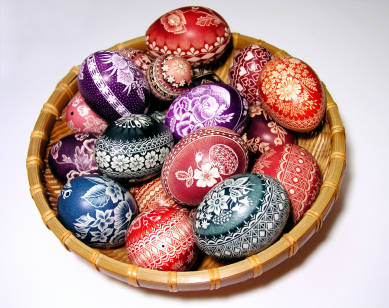
On Good Friday, people will begin preparing for Easter breakfast, especially painting Easter eggs.

A basket of painted Easter eggs

A basket of painted Easter eggs

Old Polish pagan beliefs said that eggs chased away bad luck. I would be curious to know if this is the root of the custom of painting Easter eggs in other countries as well. Many people, especially those with kids still home, will paint their own. Although just like the palms you can buy some mass-produced ones, the best ones are sold by the same little old ladies, who seem to have not moved from their sidewalk.

The faithful will prepare a grave for Christ at church, and many will take part in the Stations of the Cross processions. Each area of the city will have its own procession, with the most important one beginning at the Cathedral, and making its way through the Old Town. This procession is an “ecumenical” procession, involving representatives of other churches, including Orthodox, Lutheran, Baptist, and sometimes Pentecostal. It is based on the “Scriptural” Way of the Cross. After the Way of the Cross, a figure of Jesus will be laid in the grave, to await Easter Resurrection.

Some men will be chosen to guard the grave through Saturday, and during the day Saturday, many people will come visit the grave. When they visit, they will also bring Easter baskets to church to be blessed. These baskets are highly symbolic, with each element having some meaning connected to the death and Resurrection of Christ. However, basically, they are a wicker basket lined with a white cloth, containing some bread, kielbasa and ham, an egg, vinegar, salt and horseradish. In addition, there will be a little lamb, sometimes made of wood or plastic, but best if it’s made of bread or sugar. These baskets are blessed by a priest, and everything is ready for the Easter breakfast.

Easter Sunday begins with the Resurrection Mass at 6:00 am – another one of those great ideas that hasn’t caught on at our Baptist Church :). Easter then is a family day, and after Mass, begins with everyone sharing with one other some of the blessed eggs. Easter breakfast includes a malt soup – sometimes in a bread bowl, hard-boiled eggs, white kielbasa, cold cuts, horseradish, and a special cake called a Babka. (which is slang for little old lady – go figure).

Easter Monday has its own special tradition – old, pagan, and one of the greatest traditions in the world – but that’s for the next post.

Easter Monday in Poland

While I was posting my series on Christian Nominalism in Europe, I ran across a post from Tim Keller about nominal Christians on his Redeemer City to City blog site. Dr. Keller founded and pastors Redeemer Presbyterian Church in New York City, and is especially noted for his skill in helping skeptics understand faith in Jesus Christ.

Here’s the link to his blog post – it would be great to read the whole post: Questions for Sleepy and Nominal Christians. I’d like to share the end of his article here:

So how do you wake up sleepy Christians and convert nominal Christians? Let me give you what I would call my modernized American versions of the kinds of questions I would ask people if I was trying to get them to really think about whether or not they know Christ. These questions are adapted from The Experience Meeting by William Williams, based on the Welsh revivals during the Great Awakening. He would ask people to share about these types of questions in small group settings each week:

How real has God been to your heart this week? How clear and vivid is your assurance and certainty of God’s forgiveness and fatherly love? To what degree is that real to you right now?

Are you having any particular seasons of delight in God? Do you really sense his presence in your life, sense him giving you his love?

Have you been finding Scripture to be alive and active? Instead of just being a book, do you feel like Scripture is coming after you?

Are you finding certain biblical promises extremely precious and encouraging? Which ones?

Are you finding God’s challenging you or calling you to something through the Word? In what ways?

Are you finding God’s grace more glorious and moving now than you have in the past? Are you conscious of a growing sense of the evil of your heart, and in response, a growing dependence on and grasp of the preciousness of the mercy of God?

Put together, that is a growing understanding of grace.


I think these questions fit well with the strategy I outlined in my posts. They also fit with the idea that “God is carrying on a conversation with every person on the planet” – paradigm shifting words for me from one of my professors, Dr. Reggie McNeal.

What do you think? Do the questions fit with a strategy that revolves around the Word, life-on-life witness, obedience-based discipleship, relationship and community, in the power of the Holy Spirit? Do they speak to your heart?

Berlin Cathedralfrom wikipedia

Berlin Cathedral
from wikipedia

In part 1, I introduced a five-part strategy for reaching “secular” Christians:

The Word

Life-on-life witness

Obedience-based discipleship

Relationship and community

The power of the Holy Spirit.

This post will focus on the last two elements of that strategy.

Relationship and Community.

Relationship has two aspects – relationship with God, and with others, or community. In the Matthew passage, Jesus shows that people can do mighty works in His name, yet never have a relationship with Him. They say, “Lord, Lord,” and He says “I never knew you.”  We all have a desperate, created need for personal relationship with God. It is this intimate knowledge of Christ that allows us to take our focus away from the amazing works done in His name, and onto the hearing His words and doing what He says.

Jesus also proclaims His presence with us when we are together. “For where two or three are gathered in my name, there am I among them.” [1] This communion of at least two or three is an irreplaceable part of our relationship with Christ. We sometimes take Mt. 18:20 to mean “at least two or three”, and Jesus may have had that in mind, but perhaps He meant exactly what He said – two or three – the basic building block of community.

In that small, basic community unit we have a real chance to see life-on-life witness and obedience-based discipleship with a true opportunity for application and accountability. As two or three people interact with one another, in real life situations, they can quickly see action and reaction, speak into one another’s lives, and experience true transparency.

When we read Christ’s words from Mt. 7:16 about fruit inspection, we see how much more workable this becomes in an intimate group setting. In addition, as we understand what a contemporary European, a “secular Christian,” thinks about church, we can see that the small, core unit may be the only way to woo him to Christ. He thinks that church is a big, old, empty building; or a political system that is hopelessly out of touch; or a gang of mutually enabling pedophiles; or – at best – a group of well-meaning, but naïve individuals. The idea of the Church being family, or a squad of fellow warriors, or a trio of bff’s (best friends forever) has never occurred to him.

Relationship with Christ and one another, in community, relies on the indwelling, transforming work of the Holy Spirit. A strategy for winning “lay liberals,” though, is also dependent on the power of the Holy Spirit, the final component of our strategy.

Power of the Holy Spirit

When we include the power of the Holy Spirit as a key element of our evangelism strategy, we give more than lip-service to Him, and He becomes more than just a spiritual magic wand to make sure we include God in the midst of our hard work to win the world for Him. We actually may need to re-learn the reliance on the Holy Spirit that our grandfathers possessed, but mothers and fathers lost through a poisonous mix of reason and science, charismatic frauds, and unbiblical reactions.

Today’s European continues to search for manifestations of power. Beliefs in myriad superstitions; visits to witches, miracle healers, and New Age practitioners and reliance on astrology and horoscopes cause some to claim that animism is far from dead in Europe. “Opinion polls in Europe show high levels of belief in quasi-religious ideas such as reincarnation, but also in folk superstition: horoscopes, clairvoyance, ghosts, and so on.”[2]

Of course, the Holy Spirit is far more than just another alternative ghost. He is far more than a cosmic Force that enables His Jedi to manipulate reality. Reliance on His leading in our lives, and on His power to change others’ lives, gives us boldness, though, to proclaim His existence and demonstrate His powers of healing and transformation.

In conclusion, although Europe is faced with a rising tide of secularism, it still hangs on to the vestiges of Christianity. But it’s not enough to be a “Golden Rule Christian.” We must enter in at the narrow gate, and we are called to be faithful teachers, who call others to squeeze through that tight passage onto the unpopular trail toward life.

In total reliance on the Holy Spirit, operating in transparent community, we live and proclaim an obedience-based discipleship that can be freely examined through our life-on-life witness. Instead of relegating the Bible to a book on the shelf, between Voltaire and Nietzsche, we boldly acknowledge it as our life authority. Hearing and doing Jesus’ words, we become wise builders, not only of our own lives, but of a new form of radical Christ-following that can be both attractive and challenging for nominal Christianity.

CHRISTIAN NOMINALISM IN EUROPE III: WHAT IS A SECULAR CHRISTIAN?


[1] The Holy Bible : English standard version. 2001 (Mt 18:20). Wheaton: Standard Bible Society.

[2] Voas, David and Abby Day. 2010. Recognizing secular Christians: Toward an unexcluded middle in the study of religion (ARDA Guiding Paper Series). State College, PA: The Association of Religion Data Archives at The Pennsylvania State University, from http://www.thearda.com/rrh/papers/guidingpapers.asp. (15)

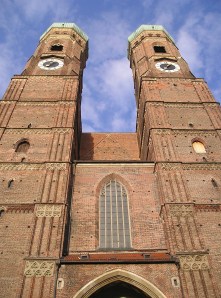
Frauenkirche, Munichfrom wikipedia

Frauenkirche, Munich
from wikipedia

This and the next post are the conclusion of a 7 part series on Christian nominalism in Europe

Taking Jesus’ words into consideration (parts 1 and 2), leaning on an understanding of what we know about “secular Christians” (3 and 4), and even using the Lausanne occasional paper as a starting grid (part 5), an effective strategy for seeing nominal Christians transformed by Christ must include the following elements:

The Word

Life-on-life witness

Obedience-based discipleship

Relationship and community

The power of the Holy Spirit.

Of course, these elements are present in any good strategy of Christian witness – and have been ever since Pentecost.  However, the application of such elements may be significantly different among “cultural Christians” from what it would be among tribal animists.

The Word.

It may be very tempting at times to avoid this point of our strategy. The average European practical atheist does not see the Bible as authoritative. So an attempt to bring the Bible into everyday conversation may be seen as fanatical, or at least weird. However, many Europeans think they know quite a bit about the Bible (even if they’ve never read any of it), and are more than willing to share their opinions. When we honestly and consistently refer to the Bible as our authority, we can work in an almost subversive way to change the way our nominal friends consider the Scriptures.

Of course, a one size-fits-all approach, which ignores the vast differences between various countries, will be inadequate. Whereas in France or the Czech Republic it may be rare to find someone who has heard the Bible read – let alone read it for herself – the average Pole, Greek or Croat has probably heard the Bible read many times in church, and likely has read a portion on his own, as well.

Of course, in humility and love, we need to recognize that the Bible is our authority – but it isn’t yet perceived as such by our neighbor. Demanding that our nominal friend submit to the Bible’s teaching is likely to produce a quite opposite effect than what we would hope for. Consistent submission to the Bible, and practicing what we read and hear, however, serves as a life-changing instrument, first in our life, and then by extension in the life of our friend – and such a witness leads us to our next strategic component:

Life-on-life witness.

The Lausanne authors referred to this as consistent life-style, presenting a lifestyle of growth, witness and caring. The key idea is that we would demonstrate Christian living in front of a watching world. We need to allow our neighbor

“to peer into our lives in order to see exactly how we are in the process of growth. We do not clearly model for others the process of change that is taking place in our lives as we apply the Word of God and learn obedience and submission to him in daily practice. This growth is demonstrated naturally if we are in the Word of God together and sharing our actions and reactions to it. This will allow those we are seeking to lead to look into our lives. It will help them to see how the hand of God is at work conforming us from faith to faith into his perfect image. It will reveal to them how we correct sin in our lives and repent from it.”[1]

We also need to model witness and caring. As we allow others to see us “in action,” we are able to live out a witness in front of them that is irrefutable. Who can argue with a life lived in obedience to Christ? However, such a life requires consistency, and especially transparency and openness. In this way, we allow others to be “fruit inspectors” in our life, following in the spirit of Jesus’ words from Matthew 7:16-20. Such a life-on-life witness demands that we take seriously the third component of our strategy:

Obedience-based discipleship.

We must first model such a discipleship in our own walk with Christ. We should not expect others to follow Christ whole-heartedly, when we ourselves do not make Him Lord of our lives. When we work as a wise builder, though, we build a life that can weather storms, and we show to others a storm-proof life.

Obedience, doing that which we hear from Jesus (Mt. 7:24), is a vital component of discipleship. In fact, it may be the one totally necessary ingredient in making disciples. After all, Jesus tells us in Mt. 28:20 that we are to “teach them to obey everything I have commanded you.” James 1:22 reminds us that a true disciple of Christ is a doer of the word, not only a hearer. Unfortunately, we have usually placed a far greater emphasis on hearing the Word. We have frequently unwittingly re-written the Great Commission to read “teaching them everything I have commanded you,” and left out the emphasis on behavior and practice. Especially in the West, we could probably scale back on the knowledge in exchange for a greater emphasis on application, action and accountability.

A couple of years ago, I was in a conference with others involved in theological training from around Europe. The presenter showed Mt. 28:20 on the screen, but left out the words “to obey.” He then asked us what was missing. No one caught the omission! We all thought, at first glance, “teaching them everything I have commanded you” was correct. Oops! Obedience, life application and accountability must be part of our discipleship.

Obedience-based discipleship, especially in the confrontation of accountability, is most effective in relationship and community – the fourth element of our strategy, coming up in part 7.

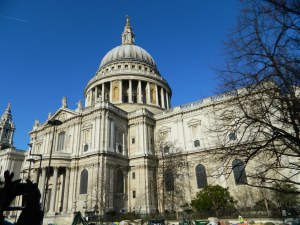
St. Paul's Cathedral, Londonfrom wikipedia

St. Paul’s Cathedral, London
from wikipedia

As we begin to consider a strategy for reaching nominal Christians in Europe, we should first return to the Lausanne Committee’s work from 1980. Although this occasional paper is over 30 years old, it still gives us a good starting point. The paper focuses on nominal Christians among Roman Catholics, and as a result some changes would need to be made in light of the fact that 1.) a large number of Europeans identify with some other church and 2.) for all Europeans, identification with a specific church is less important than it was even just 30 years ago.

“Formulation of effective strategies for reaching nominal Christians among Roman Catholics involves at least five basic components: correct attitudes, correct doctrine, consistent lifestyles, community and interaction, and practical application and solutions.”[1]

“Correct attitudes” primarily refers to an attitude of love and humility toward Roman Catholics. Both are certainly needed, but of course, not exclusively toward Roman Catholics. Since church affiliation is increasingly less important, as is identification with a particular set of beliefs, perhaps a better, more contemporary strategy would be to search for, recognize and affirm ways in which God is speaking into the life of every individual, whether a nominal Catholic, Evangelical, or Anglican, or a secular, materialistic atheist who is still searching for meaning in life.

Within the strategy component of “sound doctrine”, the Lausanne paper contributors emphasize Bible study as the key to conversion to Jesus Christ. This certainly is key, but Jesus would remind us that simply hearing His words and assenting to them are not enough for a true disciple. Bible study and daily practice are key – not of course for a salvation based on our own works, but as evidence of a radically transformed life. Thankfully, the authors continue with several areas of doctrinal emphasis, including the lordship of Christ, that emphasize both a personal relationship with a Christ, and “that the new birth results in a progressive change of attitude and behaviour. Submission of the will and learning of daily obedience should be taught as basic to true discipleship.”[2]

Further components of the strategy outlined in the Thailand paper are: consistent life-style, one that demonstrates growth, witness and caring; community and interaction, emphasizing the Body of Christ and Family of God; and practical applications and solutions, where once again being a doer of the Word, and not simply a hearer is highlighted.

The Lausanne strategy presents some excellent guiding values for all who live in cultures dominated by nominal Christians. In fact, the paper could be redacted, removing references to Roman Catholicism, and serve as a valid starting point for evangelists in all parts of the “Christian” world. Probably all committed followers of Christ, living radically transformed lives, even those who still retain an affiliation with a church populated by nominal Christians, could then boldly agree with such a strategy to evangelize their fellow “non-practicing believers.”

Taking Jesus’ words into consideration, leaning on an understanding of what we know about “secular Christians,” and even using the Lausanne occasional paper as a starting grid, an effective strategy for seeing nominal Christians transformed by Christ must include the following elements: the Word; life-on-life witness; obedience-based discipleship; relationship and community; and the power of the Holy Spirit. Of course, these elements are present in any good strategy of Christian witness – and have been ever since Pentecost.    However, the application of such elements may be significantly different among “cultural Christians” from what it would be among tribal animists.


[1] Lausanne Occasional Paper  10: Christian Witness to Nominal Christians Among Roman Catholics, Thailand 1980 from http://www.lausanne.org/en/documents/lops/55-lop-10.html

[2] Ibid.

St. Vitus' Cathedral in Praguefrom wikipedia

St. Vitus’ Cathedral in Prague
from wikipedia

In Part I and II I looked at Matthew 7:13-27 as a beginning point for looking at “nominal” Christians, and in part III, a definition of a “secular” or nominal Christian. In this post, I will look a little more closely at “secular” Christianity in Europe.

In “Recognizing Secular Christians,” Voas and Day point out that, despite the rise of secularism, “many people remain interested in church weddings and funerals, Christmas services and local festivals. They believe in something out there, pay at least lip service to so-called Christian values (mostly concerning duties to others rather than duties to God), and may be willing to identify with a denomination.”[1] Most people in Europe can still specify their religious background, and, depending on the wording of the question, will choose some Christian affiliation. In fact, these nominal Christians comprise more than half the population in most European countries.[2]

With the waning of religious influence in Europe, though, religious identity has remained, but a religious worldview has disappeared. Usually, a Christian worldview has been replaced by a secular worldview. Many Europeans still believe in God, but He is now a much more distant God. Although most Europeans would still not define themselves as atheist or materialist, they have become “practical atheists and materialists.” Of course, once again, there is a wide range of belief across Europe. Western Europe, especially France, is frequently cited as equivalent to all of Europe, and non-Europeans picture a secular, godless society – a picture that is abominable to most Poles.

However, many Europeans continue to search for a spiritual element to their lives. As one young man, fed up with organized religion, put it recently, “I couldn’t stay in the church and remain a hypocrite, giving assent to things I didn’t believe in. But I couldn’t become an atheist, either. There had to be a third way.” 41% of Norwegians, 48% of French and 54% of Czechs claim to not believe in God, but only 10%, 19% and 20% of those respondents self-identified as “atheist,” respectively.[3] Although many European countries have a high percentage of people who do not believe in God, there remain others – e.g. Malta, Ireland, Poland and Italy – where the percentage of people who do not believe in God remains well below 10%.[4] Over half of EU citizens believe there is a God (52%), and another quarter (27%) believe there is some sort of spirit or life force. Only 18% declare that they don’t believe there is any sort of spirit, God or life force[5]

So, although secularism is certainly on the rise, all across Europe, there remains a majority of Europeans for whom God has some importance. Even the Church, although perhaps limited to weddings, baptisms, and funerals, still functions as a part of their lives. In the light of Jesus’ words, though, some importance is not enough importance. In fact, the path where God has some importance seems to be the broad road to destruction, the crowded highway to hell. Religious leaders who don’t conscientiously warn their parishioners of the danger at the end of that road should take a close look at their sheepskin robes, and make sure the wolf pelt isn’t peeking through.

Of course, the words of Jesus are not reserved for a nominal Roman Catholic, Lutheran, Orthodox or Anglican. There was no brand name attached. In fact, Jesus indicates that some might even work miracles in His name – and yet never know Him. Such a description may even better fit some Evangelicals than the aforementioned denominations. And, in truth, what would be the point of converting a nominal Catholic into a nominal Evangelical? Jesus is expecting a radical life change, squeezing through the narrow gate, climbing the black (difficult) trail, building on the hearing and obeying of His commands – a life characterized by a living, intimate relationship with Him, not by affiliation with a denomination, mental assent to a set of beliefs and periodic church attendance.

In the next posts we will begin to look at strategies for life-transformation of nominal Christians. If you are in Europe, how would you describe the “nominal” Christian in your country?

[1]  Voas, David and Abby Day. 2010. Recognizing secular Christians: Toward an unexcluded middle in the study of religion (ARDA Guiding Paper Series). State College, PA: The Association of Religion Data Archives at The Pennsylvania State University, from http://www.thearda.com/rrh/papers/guidingpapers.asp. (3)

[2] Ibid. 11

[3] Greeley, Andrew. 2003. Religion in Europe at the End of the Second Millenium. New Brunswick, NJ: Transaction Publishers. Quoted in Atheism: Contemporary Rates and Patterns, by Phil Zuckerman. Cambridge Companion to Atheism, edited by Michael Martin, University of Cambridge Press, 2007

[4] Ibid.

[5] Special Eurobarometer Special Eurobarometer Wave 63.1 225 (June 2005) 9. Apr. 2010

St. Mary's Basilica, Krakowfrom wikipedia

St. Mary’s Basilica, Krakow
from wikipedia

In Part I and II I looked at Matthew 7:13-27 as a beginning point for looking at “nominal” Christians, or (borrowing D.A. Carson’s term) “small-dose” Christianity.

Three Dollars Worth of God

I would like to buy $3 worth of God, please.
Not enough to explode my soul or disturb my sleep,
but just enough to equal a cup of warm milk
or a snooze in the sunshine.
I don’t want enough of God to make me love a black man
or pick beets with a migrant.
I want ecstasy, not transformation.
I want warmth of the womb, not a new birth.
I want a pound of the Eternal in a paper sack.
I would like to buy $3 worth of God, please.

— Wilbur Rees

Three dollars’ worth of God is a pretty small dose. Yet, such a picture appropriately describes the nominal Christian. The nominal Christian identifies himself as a Christian, but this identification does not have a great deal of impact on daily life.

The phrase “secular Christians” can be applied to the most important component of the broad intermediate group. These are people who call themselves Christian, but who for all practical purposes are secular. They live in a world centered on their social relationships, in which God has no everyday role. They do not expect God’s help, fear God’s judgment, or believe that things will happen God willing. They are indifferent to religion for the good reason that it gives them nothing of practical importance.[1]

            In their article regarding the “unexcluded middle,” David Voas and Abby Day contrast such secular Christians with “religiously committed Christians who identify with a church or denomination, believe in God, and attend services with some frequency.”[2] In the light of Jesus’ final words from the Sermon on the Mount, however, such a definition of a committed Christian is much too anemic. The Lausanne Occasional Paper 10, Christian Witness to Nominal Christians Among Roman Catholics (1980) says, “The heart of true Christianity is being a disciple of Jesus Christ in the terms of faith, love, and obedience.” Such a definition is much closer to the picture of the wise builder who has entered through the narrow gate.

Several terms are used to describe nominal Christianity: “Cultural Christianity”, “fuzzy fidelity”, “believing without belonging”, or in Poland, “believing, not practicing.” Such people are sometimes termed “lay liberals” or “Golden Rule Christians.” The last term seems somewhat ironic, when one realizes that the Golden Rule, from Matthew 7:12, is immediately followed by Jesus’ words, “Enter by the narrow gate.” In addition, religious researchers see many degrees of commitment along a continuum that includes three dimensions: belief, practice and affiliation. Belief is usually measured through surveys that ask respondents whether they agree with certain doctrinal points or articles of faith. Affiliation has traditionally referred to belonging to a particular Christian denomination, although more recently focused simply on whether one identifies oneself as Christian. Most researchers measure practice based on attendance at services. “For reasons of practicality it makes sense to work with three standard measures of religiosity: self-identification with a religion, frequency of attendance at religious services, and belief in God.”[3]

However, a definition of practice that focuses primarily on attendance at church services doesn’t fit with Jesus’ words from the Sermon on the Mount, especially not with 7:21-23. Of course, such an attendance-based definition is much easier to measure. But a more biblical definition of a nominal Christian is the one used by the Lausanne Committee in the aforementioned working paper:

A nominal Christian is a person who has not responded in repentance and faith to Jesus Christ as his personal Saviour and Lord. He is a Christian in name only. He may be very religious. He may be a practising or non-practising church member. He may give intellectual assent to basic Christian doctrines and claim to be a Christian. He may be faithful in attending liturgical rites and worship services, and be an active member involved in church affairs. But in spite of all this, he is still destined for eternal judgment (cf. Matt. 7:21-23, Jas. 2:19) because he has not committed his life to Jesus Christ (Romans 10:9-10).[4]

            Of course, this type of definition is difficult to measure through surveys. In the end, only God knows the truth of a person’s heart, and only God knows the depth of His relationship with any human being. Only Jesus can say, “Enter into My presence” or “Depart from Me, I never knew you.” We can, of course, examine the fruit of a person’s life:

“What fruits does Christ seek? He seeks:

(1) the fruit of the Spirit, or Christian character as described in the Beatitudes and Gal. 5:22–23;

(2) the fruit of the lips, testimony and praise to God (Heb. 13:15);

(3) holy living (Rom. 6:22);

(4) good works (Col. 1:10);

(5) lost souls won to Christ (Rom. 1:13).

Professing Christians may be involved in religious activities and pretend to be saved, but if they are honestly born again, they will reveal these fruits in daily life.”[5]

In the next post, I will try to describe “nominal” Christianity in Europe in more detail, and summarize the Lausanne plan for reaching nominal Christians. In the final 2 parts, I will attempt to bring together the Matthew passage, what we will see about secular Christians in Europe, and the Lausanne plan as the basis for a strategy for reaching our “Christian-in-name-only” friends and neighbors. As always, questions, comments, or corrections are welcome!!

[1] Voas, David and Abby Day. 2010. Recognizing secular Christians: Toward an unexcluded middle in the study of religion (ARDA Guiding Paper Series). State College, PA: The Association of Religion Data Archives at The Pennsylvania State University, from http://www.thearda.com/rrh/papers/guidingpapers.asp. (3)

[2] Ibid. (2)

[3] Ibid. 6

[4] Lausanne Occasional Paper  10: Christian Witness to Nominal Christians Among Roman Catholics, Thailand 1980 from http://www.lausanne.org/en/documents/lops/55-lop-10.html

[5] Wiersbe, W. W. (1997). Wiersbe’s expository outlines on the New Testament (36). Wheaton, Ill.: Victor Books.