Archive for April, 2013

What is Animism?

Animism in the Bible? Part 1 of 2

There are a number of examples of animistic practice in the Old Testament, some of which are condemned. Philip Steyne refers to the idea of words having power in the stories of Balaam’s curse in Numbers 22-24 and the centurion who told Jesus to “just speak the word and my servant will be healed” in Matthew 8:8.[1] Isaiah condemns Israel’s practices of magic and witchcraft in Isaiah 47:9-15. The Israelites kept the bronze serpent on a pole from Numbers 21:1 and by the time Hezekiah cleaned out the temple in 2 Kings 18:4, it had become an object of worship, and the Jews burned incense to it. For many, the phylacteries from the Talmud, mentioned in Matthew 23:5, have become a ritual object of power that keep men from impure thoughts and give efficacy to their prayers (http://www.jewishencyclopedia.com/articles/12125-phylacteries – especially the blessings).

Two examples that look like animistic practices but aren’t necessarily are found in 1 Kings 5:10, when Naaman is told to dip in the Jordan seven times, and in Acts 19:12-16, when the handkerchiefs that Paul had touched are used to heal sick people. Animists would see Naaman’s ritual of cleansing as homeopathic magic that removed sickness, and Paul’s hankies as objects of power that removed magic by contagion.[2] The second example evokes images of modern television faith healers.

David seems to also view the ark of the covenant as an object of power, when he has it returned to Jerusalem in 1 Chronicles 13. The entire story surrounding the ark, which defeats and embarrasses Dagon, god of the Philistines, and brings blessing to the town of Kiriath-Jearim is one that is difficult to understand, without falling into our own animistic ideas of objects of power. An animist would also interpret the death of Uzziah, when he touched the ark on its way to Jerusalem, through the lenses of taboo, meaning that the object itself was untouchable.[3] Of course, the ark must have been touched multiple times both before and after – and not necessarily by ritually clean or chosen individuals. Uzziah was not killed because he broke taboo, but because he knowingly broke God’s rules, and usurped God’s place.

Simon the Sorcerer, in Acts 8, saw the Holy Spirit as a new source of power, and the laying on of hands as the ritual that conveyed that power. He was functioning logically from his own worldview, but when Peter corrects him harshly, he seems to realize his error, although he still looks to Peter as the “prayer specialist” or power broker. Again, reflection of Simon’s thinking can be seen in some branches of modern Christianity, where certain individuals are considered to have a “special anointing” that allows them to pray more efficaciously or dispense healing.

Finally, Numbers 5:11-33 shows an interesting ritual for discovering infidelity. A woman suspected of infidelity was given water mixed with dirt from the temple floor. If she was guilty, the water would cause great suffering, including making her infertile. If she was innocent, she would be fine. Philip Steyne compares this to animistic rituals, and indicates that a true animist would have no problem accepting such a ritual, although he would interpret the reasoning behind the ritual from a completely different perspective.[4] The Law, with its foundational rituals, could have been attractive for an animist. However, “while the Lord ordained the use of ritual in worship, He abhorred ritual that aimed at divine manipulation. The only actions that pleased God were those that arose from the heart (Hos 6:4–6), and true worship was to be accompanied by joy in the Lord (Dt 12:12, 18).[5]

Although there certainly are animistic practices in the Old Testament, most are condemned by God. The way some practices are understood to a great degree depends on the religio-philosophical lens used to interpret them. An animist understandingly sees an echo of the rituals he knows so well. Modern liberal scholars see the Hebrew religion as an amalgam of other pre-existing religious ideas – including animism. However, in the Old Testament, God consistently transcends nature. And “it is increasingly understood to-day that the former identifications in early Israel of a Mountain-God, a Fertility-God and a War-God, from which the ‘ethical monotheism’ of the prophets gradually evolved, are figments of scholarly presupposition and imagination.”[6] In other words, God Jahwe was wholly other from the very beginning and remains so today.

Next: Animism in Christianity


[1] Philip Steyne, Gods of Power, Columbia, SC: Impact International Foundation, 2005, p. 101.

[2] Ibid., p. 111-112

[3] Winfried Corduan, Neighboring Faiths, Downers Grove, IL: InterVarsity Press, 1998, p. 139.

[4] Steyne, p. 133

[5] T. Cabal, C. O.  Brand, E. R. Clendenen, P. Copan, J. Moreland, & D. Powell, The Apologetics Study Bible: Real Questions, Straight Answers, Stronger Faith, Nashville, TN: Holman Bible Publishers, 2007, p. 126

[6] G. Ernest Wright, “The Old Testament and Paganism” International Review of Missions Volume 40, Issue 159,  July 1951, p. 270.
In a follow-up to the ethnographic study of Poland, where some animistic ideas were revealed, I wanted to look at animism in the Bible and Christianity.

Animistic practices occur frequently in the Bible. Some have seen a latent animism in Judaism and Christianity; however, “in Biblical teaching, nature is good, but it is not a god. It is merely a creature. The Bible stands firmly against any deification of the creation. The Biblical doctrine of creation rules out all this.”[1]

Andrew, a poster from Project Reason (www.projectreason.org) would argue that we can see animism promoted in the Bible in such passages as Genesis 12:6-8, where we find Abram traveling to Shechem to visit the “oak (or evergreen) of Mamre,” supposedly a tree already ancient and revered by the time that Abram arrived.

It was on this spot that Yahweh appeared to Abram, in consequence of which he built an altar. The connection between a specific and well-known sacred tree, and the appearance of Yahweh, can’t be missed. . . The same must be said about the terebinth (evergreen) of Mamre . . . in Hebron—where Yahweh again appeared to (newly renamed) Abraham, who built another altar (Exodus 13:18 and 18:1). . . In Genesis 35:4, Jacob buries the “strange gods” he has rejected in order to worship Yahweh under the tree in Shechem, mentioned above…thus assuring that the “strange gods”, now watched over by a more powerful deity, couldn’t harm him. . . In Judges 9:6, the Shechem tree is again mentioned as the location of Abimelech’s coronation—-presumably to have divine witness to the event. (http://www.project-reason.org/forum/viewthread/13774/)

            Although the tree in Shechem (Mamre) may certainly have been worshipped by those who came before Abraham, there is no indication of God promoting a worship of the tree. And Andrew’s assumption that Jacob buried his idols below the tree because Yahweh, “the tree god,” was stronger, is reading something totally foreign back into the text. The burning bush from Exodus 3:2-5 and Deuteronomy 33:16 are mentioned as referring to an animistic fact that God dwelt in a bush. 2 Samuel 5:23-24 is also interpreted as God indwelling the trees as a sign for David to attack the Philistines. In both cases – if we understand God to have “indwelt” these inanimate objects, and not simply speaking poetically about making them burn or rustle – God’s indwelling is temporary, and neither the bush nor the trees are meant to be objects of worship or special power. God is the source of the power that temporarily “animates” the bush and the trees. “God does not inhabit the world the way a dryad inhabits a tree; He is not the personalization of natural forces. He is not the world’s “soul”; He is its Creator”[2]

Animism is probably seen in the story of the stone that Jacob slept on when he dreamed about a ladder leading to heaven in Genesis 28:11-22. Andrew claims that Jacob believed a spirit in the stone was the source of his dream, and thus he made a pillar out of the stone, anointed it with oil, and named it Beth-el (House of God). Although Andrew is repeating the debunked “Documentary Hypothesis” of comparative religion, “this stone was actually a cult object, somewhat like the sacred Black Stone of the Kaabah in Mecca. Stone worship must also lie behind the account of the cairn erected by Jacob and Laban in Gilead (Gen. 31:47).”[3]  Even the Oxford Dictionary of the Christian Church sees this as an echo of animism.[4] Although Jacob’s understanding and practice may have been flawed, he still saw God as the source of the dream, and God as the object of worship – a God who was not confined to the stone.

Some also see the “cloud by day, pillar of fire by night” as an evidence of an animistic God. Again, though, when God refers to Himself, He is not confined to a tree, stone, cloud or pillar, although He may temporarily animate them. Of course, many “lesser deities” are referred to, including Baal, Ashtarte, Moloch, Dagon and other gods. These are invariably mentioned as false gods, and their worship is condemned. One exception is a short, vague reference to Lilith in Isaiah 34:15. She was “a female goddess known as a night demon who haunts the desolate places of Edom.”[5] However, there is uncertainty as to the meaning of Lilith (could be some kind of an owl – which may also then have animistic ideas), and Isaiah could be using Edomite ideas to emphasize his message.

In part 2, we will look at some further examples of animistic practice in the Bible.
What is Animism? First part in this series


[1] N. Pearcey & C. B. Thaxton, The Soul of Science: Christian Faith and Natural Philosophy, Turning Point Christian Worldview Series, Wheaton, IL: Crossway Books, 1994, p. 23.

[2] Ibid., p. 24

[3] G. Archer, Jr. A survey of Old Testament introduction (3rd. ed.), Chicago: Moody Press, 1994, p. 151.

[4] F. L. Cross & E. A. Livingstone, The Oxford dictionary of the Christian Church (3rd ed. rev.),  Oxford; New York: Oxford University Press, 2005, p. 71

[5] W. C. Kaiser, in R. L. Harris, G. L. Archer, Jr. & B. K. Waltke (Eds.), Theological Wordbook of the Old Testament, Chicago: Moody Press, 1999, p. 479.

As a follow-up to the ethnographic study of Poland, I wanted to do some more thinking and writing about animism, specifically possible occurrences of animism in the Bible, and likely occurrences in Christianity.

In order to understand when and how animism occurs in the Bible and Christianity, we need to first define animism, and list some of its practices and beliefs. Usually, animism and Biblical Christianity are seen as being incompatible,[1] so if animism is present, it is more likely to be present in pieces, rather than as a whole.

Philip Steyne, in his book Gods of Power, describes animism on pages 34-40. “Animists believe that an impersonal power is present in all objects. This power may be called mana, or life-force, or force-vital, or life essence or dynamism. . . The person in possession of this force may use it as he sees fit, but always stands the chance of losing it.”[2] In addition to this force that is present in all objects, animists believe that spirits inhabit certain objects, places and people, and these spirits may be manipulated for one’s own benefit. [3]

Animism believes in a supreme god, who is not intimately involved with man or the world. Man looks to lesser beings for power, and lives in a world that is completely spiritual.  Two kinds of spirits are frequently venerated – ancestors and nature spirits.[4] He will look to keep these lesser powers in harmony. In fact, this may be seen as a triangle, with the supreme being (sometimes called a sky god), above ancestors and nature spirits, with humans in the middle, trying to placate all three.[5] He also focuses his attention on sources of power, especially in sacred objects.[6] Everything is connected, “through the will and power contained in both animate and inanimate objects.”[7] All of life’s questions have a spiritual answer. There is a “mysterious spiritual energy in all things. People who recognize this organize their entire lives around relating to that energy.”[8]

Power is needed to make rain, give good crops, secure employment, heal diseases, guarantee fertility, or pass school exams. Protection is needed from disease, evil spirits . . . catastrophes . . ., failure, sorcery, and witchcraft. . . Ways to secure power include contacting religious specialists, performing rituals, using medicines, contacting spirit beings or ancestors, worshiping ancestors, using charms and fetishes, participating in ceremonies, observing taboos and going on vision quests.[9]

            This power may be objective, not dependent on the person who possesses the power, or it may be subjectively dependent on the person and his “life force”. Expertise of the power broker is important, as may be his health or virility (life force), or the power objects he possesses.[10] The animist has a religion based on works, and the correct following of rituals and liturgies is paramount. If faith enters, it is “faith in his own ability to make things work in his favor.”[11]

When we look for evidences of animism in the Bible and Christianity, frequently man’s desire for power impels him toward animistic thinking or practices. Although theologically, “the godlike creatures of animism and the creator-God of Christianity have next to nothing in common,”[12] we will see that man tends toward power sources that he can manipulate, rather than toward a God that is the source of all power, free of manipulation and jealous of His own glory, but also infinite in love and grace.

Next up: Animism in the Bible?


[1] G. Ernest Wright, God Who Acts, London: SCM Press, 1973, p. 20

[2] Philip Steyne, Gods of Power, Columbia, SC: Impact International Foundation, 2005, p. 34

[3] Ibid.

[4] Winfried Corduan, Neighboring Faiths, Downers Grove, IL: InterVarsity Press, 1998, p. 136

[5] Ibid, p. 137

[6] Steyne, p. 36

[7] Ibid., p. 37

[8] Corduan, p. 136

[9] Steyne, p. 38

[10] Ibid., p. 39

[11] Ibid.

[12] D. Story, Defending your faith. Grand Rapids, MI: Kregel Publications, 1997, p. 112

This ethnographic survey has deepened my understanding of my adopted homeland. Although Catholicism is the dominant religion, it was very interesting to see the animistic influences, and the prevalence of postmodernism. I also want to continue to ask all of my Polish friends some of the questions from the survey. One of the benefits to conducting a conversation in this manner was the way that the conversation could naturally turn to spiritual topics. Two ladies told me after our conversation that they felt like they had just been to confession. One couple that I interviewed has been our acquaintances for 11 years – and this was the first time we talked about spiritual issues. I’m looking forward to seeing what else we discover, and how we can use that to serve better in Poland.

I’m including the questions that I used – maybe someone else will be interested. The English questions are from the Human Relations Area Files at Yale University. The Polish questions combine a few of the English questions, and my friend Radek helped me by correcting my Polish. The questions are designed to not point people toward certain answers, so for instance Christian terminology is avoided. A couple of the questions in Polish required me to explain a little what I meant. They are correctly translated, but I think the topic was a little too foreign.


Ethnographic Questionnaire

  1. Who do you tend to listen to, and why?
  2. Are some people thought of as more important than others, and why?
  3. What do you believe about death?
  4. What do you think happens to a person when they die?
  5. Where do people go in Poland to find spiritual power?
  6. How do you define spiritual success?
  7. Do you believe in spirits?
  8. What kind of spirits are there?
  9. Do ancestors affect your life now?
  10. How does a person gain spiritual power?
  11. What role does luck play in everyday life?
  12. Do you have any practices that relate to controlling luck or fate?
  13. Do you have any special or sacred objects?
  14. Are there places where spiritual power is evident or available?
  15. Have you ever gone to a sacred place for blessing? What was that like?
  16. What do you believe about God?
  17. How do you feel when you come into a holy place?
  18. Are there certain things or places that you avoid?
  19. How do you discern the will of God?
  20. Are there spiritual specialists that you or people in Poland consult? Describe these and the functions they fulfill.
  21. What important religious organizations exist in Poland?
  22. Do they have much authority?
  23. Describe the leaders of these organizations? How do they relate to other people?
  24. How much trust do you place in science?
  25. What questions can science not answer?
  26. Which has greatest priority in your thinking, people or production?
  27. Do you consider that rules apply equally to all persons or do some people have special privileges?
  28. Is time more important in your day to day life or do you feel comfortable enjoying events and not paying attention to time?
  29. How do you determine whether something is right or wrong?
  30. How do you determine whether something is true or not?
  31. What factors are important in proving something?
  32. Do you believe certain things in spite of what you think may be true?
  33. Do you cling to certain beliefs in spite of evidence to the contrary?


Polish version of questions – redacted for clarity:

  1. Kto jest dla Ciebie autorytetem, i dlaczego?
  2. Co się stanie z człowiekiem po śmierci?
  3. Skąd ludzie najczęściej czerpią duchową siłę?
  4. Jak byś zdefiniował duchowy sukces?
  5. Czy wierzysz w duchy? Jeśli tak, jakie duchy istnieją?
  6. Czy uważasz, że twoi zmarli przodkowie mają wpływ na twoje życie?
  7. Jaką rolę, według Ciebie, odgrywa fart lub pech w codziennym życiu?
  8. Czy masz jakieś sposoby na kontrolowanie swojego losu?
  9. Czy posiadasz jakieś przedmioty, które mają dla ciebie duchową wartość?
  10. Czy uważasz, że są miejsca, gdzie duchowa moc jest obecna lub dostępna?
  11. Czy byłeś kiedykolwiek w takim miejscu? Jak się czułeś?
  12. Czy są miejsca, które uważasz, że maja negatywny wpływ na Twoje życie?
  13. Spróbuj opisać swoimi słowami swoje wyobrażenie Boga lub istoty wyższej.
  14. W jaki sposób możesz odkryć wolę Boga?
  15. Czy są duchowi eksperci w Polsce, z którymi ludzie się skonsultują? Jakie funkcje oni spełniają?
  16. Jakie ważne organizacje zajmującym się rozwojem wewnętrznym człowieka istnieją w Polsce?
  17. Czy mają jakiś autorytet dla Ciebie?
  18. Proszę opisać przywódców tych organizacji. Jak oni traktują innych ludzi?
  19. Na ile ufasz nauce? Na ile nauka kształtuje twój światopogląd?
  20. Czy są pytania, na które nauka nie potrafi odpowiedzieć?
  21. Czy uważasz, że zasady dotyczą wszystkich jednakowo?
  22. W jaki sposób rozsądzasz czy coś jest prawdą albo fałszem? Jakich kryteriów używasz?
  23. W jaki sposób rozsądzasz czy coś jest dobrem albo złem?
  24. Co Ciebie przekonuje?
  25. Czy masz jakieś przekonanie, pomimo tego, że to może nie spełnić kryteriów prawdy?

A Polish worldview is also strongly reliant on manipulation. The animistic elements we saw in our study contribute to this, as does as the common understanding of Roman Catholicism. The idea that we must be good enough to get to Heaven creates guilt, feelings of inadequacy, and a loss of hope. However, if we aren’t good enough, we can always rely on going to church, buying masses or indulgences, or – and here is the only hope for the mortal sinner who lacks in material wealth – suffer through purgatory long enough to make it to heaven. In any case, the system – even God’s system – can be manipulated. In fact, many Poles highly value something they call “kombinowanie”, which is loosely translated as “working the system.”

Animism covered with a 1000-year old veneer of Catholicism has also produced a strong legalism. On the one hand, this has probably been the most significant reason why divorce, homosexuality and abortion are still rare. The shame connected to all of the above practices keeps them in check. On the other hand, Poles don’t usually consider God or Church as contributing to their happiness.[1]

Manipulation and legalism remain prevalent in the evangelical church, as well. We who proclaim a Christ who died once and for all, who proclaim a salvation sola gratia still think we can work the system, and add our own rules to God’s unmerited favor. In addition, working the system is still praised by many evangelical leaders – even now that the political system is no longer blatantly anti-God. We wallow in a slough of legalism, but continue to use the only methods we know – working the system – to try to clamber out. And we can’t make it.


Galatians 5:1-15; with a glance toward the Prodigal Son, Luke 15:11-32

Paul addresses our problem in Galatians 5, and points us toward freedom in Christ. Manipulative false teachers had preached the necessity of following the law, in addition to belief in the Christ. The practice of circumcision is used by Paul as an example, “but for a Gentile Christian to accept circumcision by choice, as a matter of religious duty, implied the acceptance of the whole way of life to which circumcision was the initiatory rite.”[2] And Paul says that “for the Galatians to submit to circumcision as a legal obligation would be an acknowledgement that law-keeping (in this particular form) was necessary for the achievement of a righteous status in God’s sight. Such an acknowledgement would be to nullify the grace of God”.[3]

Instead of a voluntary return to the slavery of the law, Paul points us toward freedom in Christ. “For freedom Christ has set us free; stand firm therefore, and do not submit again to a yoke of slavery”[4] “The juxtaposition of an indicative followed by an imperative is a common grammatical feature in Paul’s writings . . .The imperative, ‘Stand firm,’ not only does not contradict the indicative, ‘Christ has set us free,’ but in fact results from it. Because of who God is and what he has done for believers in Jesus Christ, Christians are commanded to ‘become what they are.’”.[5]

We are free – at the moment of salvation, Christ set us free. Free from the bondage of sin, but also free from the bondage of law. However, by returning to the slough of Law, we deny the power of grace. Chrystostom put it this way: “He that is circumcised is circumcised for fear of the Law, and he who fears the Law, distrusts the power of grace, and he who distrusts can receive no benefit from that which is distrusted. Or again thus, he that is circumcised makes the Law of force; but thus considering it to be of force and yet transgressing it in the greater part while keeping it in the lesser, he puts himself again under the curse. But how can he be saved who submits himself to the curse, and repels the liberty which is of Faith?”[6]

Our identity, according to Paul, is that of sinners set free. In verses 2-4 Paul describes the potential results when we voluntarily choose a different identity. We are in danger of “falling from grace” and being “severed from Christ.” Why? Because when we choose law and legalism, a manipulation of the system, we choose our own ability to keep the rules (or at least work the system) instead of a total reliance on the Christ who died for us. Christ is really of “no advantage to us,” because we don’t need Him!

In the story of the unProdigal Son, shown in Luke 15:11-32, Jesus describes a similar attitude in the elder son. Tim Keller, in his book The Prodigal God, describes the attitude in this way: “You can avoid Jesus as Savior by keeping all the moral laws. If you do that, then you have ‘rights.’ God owes you answered prayers, and a good life, and a ticket to heaven when you die. You don’t need a Savior who pardons you by free grace, for you are your own Savior.”[7]

Paul says that only faith working through love really matters (v. 6). Of course, he reminds us that freedom is not to be used as “an opportunity for the flesh” but is to be used to serve one another (v. 13). In fact, he summarizes the law – and our responsibility to it – with Jesus summation of the law: You shall love your neighbor as yourself (v. 14, cf. Lev. 19:18 and Mark 12:31). Paul seems so frustrated by the manipulative false teachers that he wishes they would take their circumcision knives to themselves – and slip – cutting off not just the foreskin, but the entire organ. (v. 12)

The key issue is an issue of identity. And this is where we can address the issue of legalism and manipulation for Polish believers. We are sinners, saved by grace, through faith – not through our own works (Ef. 2:8,9). We start from faith – we don’t work toward it. “Using the devices of condition-result and contrast, Paul succeeds in asking and answering a key question: What could circumcision, and the opposing identity it represents, possibly add to the freedom already possessed by the Galatian believers? Paul’s answer: Absolutely Nothing!”[8]

So, instead of a Christ-denying legalism, whether based on our evangelical rules or Catholic sacraments, we proclaim a freedom in Christ, based on His death and God’s grace. It’s not a cheap grace – it cost Him everything – nor is it an excuse for unholy living. Actually, it’s the foundation for love and good works. But, in proclaiming our true identity in Christ, we emasculate legalism and remove the need to manipulate God with our rituals, rules and relics.

In the final post, I’ll give a short conclusion to the ethnographic report, and include the questions we used.
Ethnographic Study of Poland IV: Postmodern Animism


[1] http://www.diagnoza.com/data/report/report_2009.pdf 15% of the respondents listed “God, Providence” as an important contributor to their happiness

[2] Bruce, F. F. (1982). The Epistle to the Galatians : A commentary on the Greek text (229). Grand Rapids, Mich.: W.B. Eerdmans Pub. Co.

[3] Bruce, F. F. (1982). The Epistle to the Galatians : A commentary on the Greek text (229). Grand Rapids, Mich.: W.B. Eerdmans Pub. Co.

[4] The Holy Bible: English standard version. 2001 (Ga 5:1). Wheaton: Standard Bible Society.

[5] George, T. (2001). Vol. 30: Galatians (electronic ed.). Logos Library System; The New American Commentary (352–353). Nashville: Broadman & Holman Publishers.

[6] Schaff, P. (1997). The Nicene and Post-Nicene Fathers Vol. XIII (36). Oak Harbor: Logos Research Systems.

[7] Keller, Timothy. (2008) The Prodigal God (37-38). New York: Penguin Books Ltd.

[8] Duvall, J Scott. “Identity-Performance-Result” : Tracing Paul’s Argument In Galatians 5 And 6.” Southwestern Journal Of Theology 37.1 (1994): 32. ATLA Religion Database with ATLASerials. Web. 2 Nov. 2011.

Poland is undeniably Roman Catholic, statistically and culturally. In light of its Catholicism, the following instruction from a Lausanne paper still rings true: “Formulation of effective strategies for reaching nominal Christians among Roman Catholics involves at least five basic components: correct attitudes, correct doctrine, consistent lifestyles, community and interaction, and practical application and solutions.”[1]

However, the ethnographic survey we did showed me, in part, how superficial that same Catholicism is in the lives of many Poles. Most of the people in our survey cling to beliefs that seemed animistic – regarding the spirit world, ancestors, places of spiritual energy, and ways to achieve spiritual success – not to mention the magic spiritual qualities attached to relics, crucifixes and pictures of Mary. In addition, all of the people in our survey were postmoderns – with the possible exception of our oldest male. The relativity of truth, the reliance on feelings for direction, and the subjective nature of what it meant to be “good” all portrayed a postmodern worldview. And I was surprised! Twelve years as a participant observer, and I still thought Catholic influence had kept Poland more modern than postmodern.

So, although the Lausanne paper mentioned above is still appropriate – it’s general enough to apply to postmoderns as well as Catholics – I think some adjustments need to be made in my own apologetic approach. A consistent lifestyle, community and interaction – from the above strategy – should be top priorities. A defense of absolute truth remains necessary – but it will be ignored if not accompanied by relationship and a consistent lifestyle. Some of our respondents mentioned they listen to people who demonstrate compassion and sacrifice on behalf of others. People like Mother Theresa. Jesus asks the same of us. When we love and live for others, we will gain a hearing.

We also need to rely more on the power of God and prayer. Animism is a utilitarian view of God, dependent on objects and rituals to manipulate the spirit world. In addition, we need to be careful not to fall into an evangelical animism that simply replaces one ritual for another. Thankfully, we have immediate access through prayer and a relationship with the Creator of the Universe to unlimited power that can radically transform lives. The Shrine of the Black Madonna in Częstochowa will not save Poland, nor will the many new relics from John Paul II. The Jewish Messiah, despised and rejected, crucified for our sins – once and for all – can save Poles.

Next up: Freedom in Christ from the burden of manipulating God.

[1] LOP 10: Christian Witness to Nominal Christians Among Roman Catholics, Thailand 1980

Ethnographic Study of Poland I

Ethnographic Study of Poland II: Ontology

In the next section of the ethnographic study I did in Poland, with the help of one of my teammates, we look at axiology (the study of values) and epistemology (the study of knowledge, especially how knowledge is acquired). Again, there were 11 respondents in total, and we went through an hour-long interview with each, based on selected questions used in HRAF (human relations area files) from Yale University (subscription needed)

Axiology

1. Ethics

We didn’t ask any questions that related specifically to ethics, but two questions prompted ethics answers. “How does a person gain spiritual power?” and “How would you define spiritual success?” elicited responses that included following rules, especially the Golden Rule, and an inner peace based on knowing you are doing right.

In addition, the question about discerning God’s will usually brought a response connected with doing good. Although 3 people equated God’s will with fate, 2 people said that we could discover God’s will by following the 10 commandments. 1 person said we could discover God’s will by doing what we thought was good – but said that it had nothing to do with what God says. In the section on epistemology, we will see that most people had a relative view of good and evil, right and wrong, based on how they felt. This view showed up in this question as well, with the idea that discerning God’s will, through being good, was more something that was felt internally than an external set of rules.

2. Exceptions

We asked if rules apply equally to all persons, and most respondents said yes, they do. However, most respondents also indicated that in reality, some people got better treatment than others. Different reasons were cited, including “friends in high places,” possessing more money, or political clout. One person said, “those who make the rules think they are above the rules.” Another described the reality as a “hierarchy” in government and business that allowed for more privileges.

Epistemology

The majority of the questions focused on Polish epistemology. This was the worldview component that I most wanted to study, and the one that seems to be least addressed by other sociological research. I will only cover two areas, but I want to continue to explore Polish epistemology even after this project is complete.

1. Authority

Pope John Paul II: Poland's primary authority

Pope John Paul II: Poland’s primary authority

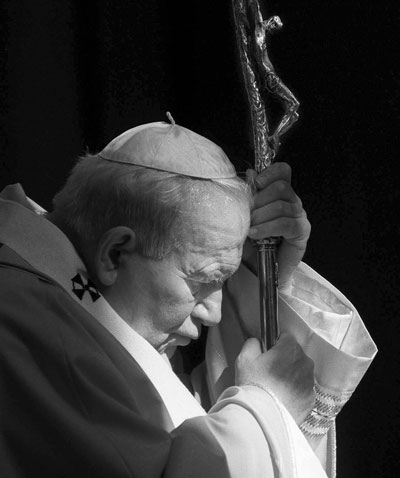
I mentioned in part 2, Ontology, that the Church was not really seen as an authority any longer, but John Paul II still was. Other persons mentioned included Mother Theresa and the Dalai Lama. Most commonly, however, people mentioned a parent – especially their mother. Two young men mentioned their father as an authority for them, and two people said that anyone who cared about people and invested themselves in serving other would be an authority for them. Two men also mentioned that anyone who had knowledge and experience in a given area would be considered an authority.

Our sample was small, but the men tended to identify authority with knowledge and competence, while the women looked at relationship, and the aforementioned investing in others. This trend also carried through in the component of truth determination.

2. Truth

We asked the question, “how do you determine whether something is true or not?” The most common answer was: “intuition.” According to most respondents, you just know. A few respondents said you feel it, or have an inner peace, most however made a connection with knowledge that you already possess. Two people also said they would ask others, trusting the opinions of their friends to determine what is true. One person (the oldest male) said that he would search for proof. Opinions, knowledge, and objective proofs formed his framework for determining truth.

No one indicated any kind of absolute standard for truth and falsehood. Although the Ten Commandments were mentioned as rules for ethical behavior, the Bible was never mentioned as having anything to do with a truth standard. In fact, with perhaps the exception of the oldest man, the idea of a standard, absolute truth would probably be unacceptable. Not only was the Bible not mentioned, but the Church wasn’t either. For nearly every respondent, truth was a personal, subjective issue.

Science was trusted, in the physical realm, but all but one person indicated that science could not answer all of life’s questions. And a couple of people were wary of science, pointing out that certain scientific assumptions or “discoveries” had later proven to be wrong.

The responses to our questions led me to describe contemporary Polish culture as animistic, with strong Roman Catholic influences (or Catholic, with strong animistic influences), but with a much larger degree of postmodernism than I expected to see. Postmodernism especially showed up in the epistemological portion of our study, in the subjective nature of truth.

In the final two posts, I’ll share some thoughts that our study prompted, regarding Polish postmodern animistic Catholicism.

Ethnographic Study of Poland I

Ontology is the philosophical study of being – what exists, what does it mean to exist? Our study focused specifically on the existence of God, the spirit world, and life after death. We also asked some questions relating to the influence and authority of the church in the lives of Poles. In the paragraphs below, it would be helpful to remember that the total number of respondents was 11, although not everyone answered every question.

1. God

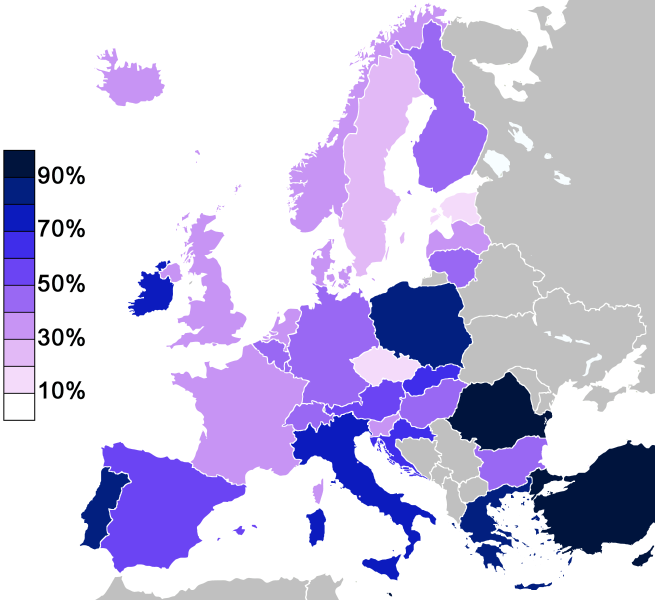
In 2008, the Polish Center for Public Opinion Research conducted a poll that indicated that 94% of Poles believe in God.[1] Earlier research done by the European Commission in 2005 showed 80% of Poles believe in God, with another 15% believing in some spirit or life force.[2]

Eurobarometer 2005 Belief in God

Eurobarometer 2005 Belief in God

Of the 10 people who responded to our question about God, one didn’t believe in God, and two weren’t sure if he existed. One of the seven who believed in God had nothing to say about his perception of God. However, seven people – including one of the ones who wasn’t sure he existed – had a description of God.

Of those seven, three thought of him as a person (including one of our afore-mentioned agnostics). The other four thought of God as a force, or energy. The personal terms included “Almighty” “merciful”, and “forgiving”. One young man sheepishly referred to God as a “kind old grandpa.” The ones who specifically described God as a force said that He is a powerful, positive energy for good. These respondents indicated that God works in people’s lives, that He gave a feeling of security, that He was the quintessence of knowledge – but yet, they did not see Him as a person.

As an aside, the fact that in English, in this section, I use a male, personal pronoun for God has no connection with how our respondents referred to God. In Polish, the word God is male and personal, but it’s a function of grammar that then requires the pronoun to also be male and personal, in the same way that in Polish “car” is male and requires a male pronoun, and “truck” is female and requires a female pronoun. Although it may be that the majority of Poles think of God as male – without it simply being a function of grammar – our respondents showed a surprisingly high incidence of thinking of God as non-personal.

2. Death

For many of our respondents, the issue of death seemed to be the one that most engaged an emotional response – and even influenced the rest of the conversation. One person – the atheist from above – said that death was purely biological, and the person ceased to exist. 10 of the respondents were not sure – calling death a big question mark – although they had a few ideas. Two young men said they tried to never think about death. One young man said the Moslem idea of death was better – going to heaven and having 40 virgins. Only one person stated what I would consider a Catholic view of death – that when we die, we go to purgatory, and then on to either heaven or hell. According to him, even an atheist would have a chance in purgatory. The most common idea was that after death, we live on, not as a soul, but as a force, or a ghost, in a different dimension. We remain able to see what happens here, and sometimes to influence it. Not a single respondent thought of life after death as a corporeal existence.

3. The Spirit World

The view of death is intertwined with the view of the spirit world. Three of the male respondents do not believe in ghosts, or in any kind of spirit. They also didn’t see their ancestors as having any influence over them, other than genetic, or perhaps as an example to follow. All of the female respondents, and two of the men, however, do believe in spirits. One person (our faithful Catholic from above) specifically mentioned the “Holy Spirit”, and several believed in good and evil spirits that can possess a person.

I was surprised at the stories that the questions about spirits and our ancestors prompted, however. Several respondents began to share how their dead mother or father had talked to them, intervened in their life, or rescued them from danger. Even one lady who said she didn’t believe in ghosts went on to share two stories of how her mother, after death, had rescued her. Three people used the idea of “guardian angel” and “dead parent” interchangeably.

The question of death, spirits, and ancestors is one that should be explored much further. With the importance of All Saint’s Day in the Polish calendar, and the important Catholic practices of prayers and masses for the dead, it is easy to see how significant this issue is for Poles – and we evangelicals focus our attention on attacking Catholic practice, rather than attempting to understand the functional worldview of those around us, and proclaiming the real hope of eternal life in a New Heaven and New Earth.

4. The Church

The Church was reviled, criticized and kicked to the curb by most respondents. And I emphasize – all of the respondents would consider themselves Catholic. It was not mentioned as a place of spiritual growth, nor were its leaders considered to be authorities – with the glaring exception of John Paul II, who made nearly everyone’s list of authority figures.

Church buildings were sometimes mentioned as sources for spiritual power – because of the opportunity they provided for a person to concentrate, pray, and notice the beauty of the décor. But church services and church leaders were not considered. The Roman Catholic Church as an organization was not described positively and priests were divided into two groups – those who had a real calling, and cared about people; and those who didn’t. Our faithful Catholic from above said the Church has authority in spiritual matters, but then said, “The Church has authority on Sunday. Only.”

As an observer, I would say that Poland is in a time of upheaval concerning the influence of the Roman Catholic Church in society. There is a media and popular backlash right now against church personalities and positions. This probably partially explains some of our respondents’ negativity. However, some of the issues are deep-seated and enduring. It is likely that the Church’s position will continue to weaken.

"Christianization of Poland on April 14, 966" by Jan Matejko

“Christianization of Poland on April 14, 966” by Jan Matejko

My wife and I moved to Poland in the spring of 1999 to help the evangelical church with church planting and leadership development. Of course, at first we focused on learning Polish, and trying to understand Polish culture and worldview. My second year in Poland, I audited theology classes at the Catholic University of Lublin, in an attempt to better understand the Polish worldview.

For the past fourteen years, therefore, we have been involved in participant observation, and yet sometimes our observations did not seem to match what we expected to see from Roman Catholics. Of course, some of our dissonance was as a result of our mistaken preconceptions about Catholicism, and yet much of it was because of a real difference between what the Church officially teaches, and the functional worldview of most Poles. Hence, I looked forward to this ethnographic project, as an attempt to better understand that functional worldview, and hopefully to gain some insight into better ways to communicate the good news of the Gospel, and especially to understand the epistemology of the average Pole.

I currently pastor a Baptist church in Lublin, Poland, and lead the WorldVenture Poland team, but I did not want to build an ethnography of evangelical Poles. I discussed the project with other evangelical pastors in our area, and with our team, and one of my team members, Bruce, in Lubin, was also interested in doing the ethnographic questionnaire among his English students. So, he met with 4 men, ages 18-38, and sent me the results of his conversations. I met with 6 people, 4 women and 2 men, ages 23-51. After preparing an English questionnaire for Bruce, I met with my friend, Radek, to correct my Polish questionnaire. As a result of our meeting, we redacted the questionnaire from 33 questions to 25, but Bruce continued to use the original. All of the participants in the research are Roman Catholic, although a few would not consider themselves faithful to or in agreement with the Church’s teaching.

I have already shared this project with my teammates and with workers from other organizations here in Poland. Hopefully, our ongoing conversation and research into the Polish worldview and our Christian witness can help us better proclaim the Good News.

  1. History and Demographics

Poland was founded in 966 A.D. when King Mieszko I was baptized into the Western Latin rite. This decision meant that Poland remained Roman Catholic when some of its southern and eastern neighbors went with the Eastern (Orthodox) Church. Being Roman Catholic also meant a focus toward Rome and the West, rather than toward Constantinople and the East. As a result, religious, cultural and political ties integrated Poland with its Western neighbors, Austria and the German states, as well as with Lithuania when it also chose Catholicism. The Union of Lublin, in 1569, created the Commonwealth of Poland-Lithuania, a nation-state which for nearly two hundred years was among Europe’s largest countries.

Poland considered itself a bulwark against the Baltic pagans, the Orthodox Russians, and later, the Moslems from the east and south. The role of King Jan III Sobieski in the Battle of Vienna (1683) to turn back the Ottomans was crucial to stopping the Moslem advance into Europe. Poland was a relatively tolerant society, with large numbers of Jews, Orthodox, pagans and even Moslem Tatars holding positions of prominence. The Reformation also saw many converts to Protestantism, especially Calvinism. However, wars with Protestant Sweden, most notably “the Deluge” (1655-60), led to a marked change in Polish tolerance, including the banishment of the Arian Brothers (a sect similar to the Bohemian Brethren), and the death penalty for conversion from Catholicism.

The valiant defense of the monastery of Jasna Góra in Częstochowa during the Swedish Deluge, and the legends surrounding the icon of the Black Madonna, housed in the monastery, greatly assisted in the process of counter-Reformation in Poland. Still today, nearly every high school student in Poland makes a walking pilgrimage to the Shrine of the Black Madonna in Częstochowa. Although Poland continued to be relatively tolerant – in comparison with most other European countries – the religious beliefs of its citizens were tied to their ethnicity. Russians – Orthodox, Germans – Protestant, Jews, Moslem Tatars – and Poles were Catholic, with very few exceptions.

The Divisions of Poland among the Great Powers of Russia, Prussia and Austria in the late 1700’s, its rebirth in 1918, and World War II, led to a Poland that is today much less diverse, both ethnically and religiously. Poland is 97% ethnically Polish,[1] and is 89% Roman Catholic, 9 % non-religious, 1% Orthodox, and 0.5% Jehovah’s Witness. Lutherans are 0.22%, and Evangelicals are about 0.14% of the population.[2] The Lutheran and Orthodox adherents usually have a German or Russian ethnic background, respectively, so the common expression “to be Polish is to be Catholic” usually rings true.

  1. Social Structures

Family remains very important in Polish society. As I conducted my survey, nearly every respondent mentioned their father or, more often, their mother, as an authority figure. Those who had lost a parent believed that their dead parent still took interest in their lives, and in a couple of cases, believed that the dead loved one had intervened to rescue them from some calamity. A mass migration began in 2005, when 5% of the population moved to Western European countries in search of work, and this has begun to lead to a more mobile society, but families still remain in close proximity. Every year, the holiday that sees the most travel is not Christmas, or Easter, but rather All Saints’ Day, when families return to their home areas, and visit the graves of their loved ones. As one of my friends described it, “in this way we can include our whole family, alive and dead, in All Saints’ Day.”

The cultural diagnosis report of 2009 states that respondents listed “successful marriage” as the top (56%) condition for happiness. This also indicates the high value that Poles place on family. Once interesting trend, however, is that “friends” has doubled in importance for happiness since 1992[3]. This helps explain why one of my interviewees, when asked about ancestors influencing us, said that other loved ones who have died, not just those related to him, still influence his life today, and that he asks them for advice. Family is very important, but there is a growing trend toward looking for the most important relationships outside of family.

This post is a reflection on a guest lecture by Dr. Ed Smither in my class “The Mission of God” at Columbia International Seminary, taught by Dr. Mike Barnett. Dr. Smither has a special interest in the history of missions in North Africa, and wrote his Ph.D. on Augustine as MentorYou can (should) check out his blog: www.edsmither.com. I don’t believe I can post his entire lecture – although I’d love to. I would like to post his “summary of strategies” used by early missionaries, though.

1. Proclamation (full-time, bishops, monks, lay people)
—2. Favor with kings and political leaders
—3. Monastic mission centers.
—4. Suffering (Ignatius, Polycarp, Scillitans, martyrs of Lyons, Perpetua and Felicitas, Cyprian)
6. —Scripture translation (Syriac, Coptic, Armenian, Gothic, Latin)
—7. Holistic mission (healing, spiritual warfare, caring for the poor)

I was most intrigued by some of the lessons learned during early Christian mission, shared by Dr. Smither. That period of history has always interested me, especially when considering the growth of the church. Two lessons especially resonated for me: the use of miracles and other power encounters, and the fact that everyone was involved in the proclamation and spread of the gospel.

Gregory Thaumaturgos, Martin of Tours, Augustine of Canterbury, Boniface – all used miracles and power encounters. Some, like Boniface, saw this as a strategic method of winning pagans by demonstrations of the power of God. I got the impression, though, that many of the others treated miracles and other manifestations of God’s power as normal expressions of their faith.

Dr. Smither summarized this as “holistic ministry,” and this does serve to underscore the importance of modern holistic ministry. In spite of my fundamentalist background, I have come to realize just how important are the manifestations of God’s power today, and how important it is to meet people’s physical needs, even while maintaining the preeminence of proclamation. Our international fellowship in Lublin began just after a miraculous healing of a Hindu American student – as a result of this very non-charismatic Baptist praying over his comatose body. (You can read that story here). It’s exciting to hear and read about God’s power manifested in the early centuries of the church, as well, and to understand that God has always been working in similar ways throughout the history of the church.

The other amazing lesson came from the way God used all kinds of people to advance His Kingdom. Usually the merchants and soldiers went first, but the priests and monks were close behind. Slaves played a key role as well, especially in taking the gospel to countries that we would today call “creative access nations.” Everywhere these Christians went – they took their faith, talked about it, and people converted.

As a “professional” missionary, it was nice to see that other “professionals” had blazed a trail as well – priests and monks. However, it was both encouraging and humbling to realize that the pioneers were usually business people. As they conducted their business, they travelled. As they travelled, they told others about their greatest treasure. Sometimes the professionals would follow and help deepen the faith of people who had already heard, but usually when a missionary monk went somewhere – the gospel had gone on ahead already. Dr. Smither called this a proclamation strategy – by bishops, monks and lay people. And it still takes everyone proclaiming the gospel to adequately reach a people for Christ. The full-time missionaries are invaluable, but so are the people involved in business as mission, the NGO aid workers, the Christian international businessmen and even the soldiers who still share the gospel.